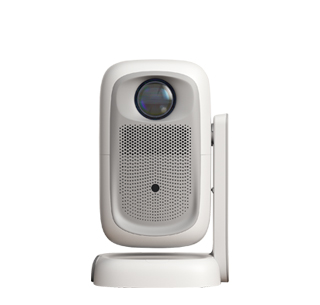
The operating system (OS) of smart projectors is a core component that determines the user experience, and modern smart projectors have made remarkable progress in system fluency, functionality, and user-friendliness, making them generally easy to use even for elderly and novice users. Unlike traditional projectors that require connection to external devices (such as computers and set-top boxes) to play content, smart projectors are pre-installed with intelligent operating systems, integrating functions such as online video playback, application installation, voice control, and wireless projection, realizing a "one-machine integration" experience that is simple and convenient.
Most mainstream smart projectors adopt customized operating systems based on Android, such as Dangbei AI OS, GMUI, and MIUI, which have optimized the interface design and operation logic for projection scenarios. These systems usually adopt a horizontal content partition + vertical content stream layout, with a simple and intuitive interface: the upper part displays recommended video content, and the lower part classifies content by type (such as movies, TV dramas, variety shows, and children’s programs), allowing users to quickly find the content they want. In terms of fluency, mainstream smart projectors are equipped with high-performance chips and sufficient storage space (usually 2GB+32GB or higher), ensuring that opening applications, switching content, and browsing interfaces are smooth without lag. For example, Dangbei AI OS 6.0, which is widely used in many smart projectors, has no boot ads and can enter the main interface in 5 seconds, with extremely fast response speed[5][7].
The user-friendliness of smart projector systems is also reflected in practical functions such as voice control, automatic correction, and multi-device connection. Most models support voice control, which is connected to AI large models, allowing users to control the projector through voice commands (such as "play Avatar 2," "adjust brightness," and "query the origin of the solar system") without using the remote control, greatly reducing the operation threshold. In addition, functions such as real-time non-inductive automatic correction and automatic focusing (realized through 3D ToF modules and CMOS sensors) allow the projector to quickly adjust the picture to a standard and clear state even if it is moved, eliminating the need for manual debugging by users. At the same time, smart projectors support wireless projection (such as AirPlay, Miracast) and wired connection, which can easily connect to mobile phones, tablets, computers, and other devices to share content. Some systems also support installing third-party applications, further enriching the functional experience. Overall, the operating system of modern smart projectors is designed with user convenience in mind, with simple operation, rich functions, and high fluency, fully meeting the needs of daily use.
Read recommendations:
HW30 Home Cinema - HW Series Projector
3d Projector small body big screen
Zero-Delay Mobile Phone Screen Casting Method for Projectors










 Reviewed: