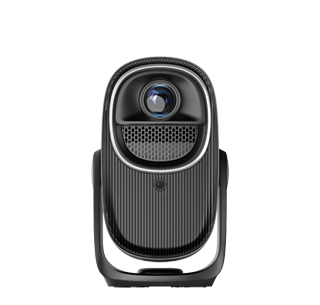
Many users confuse light source lumens and actual projection brightness when purchasing projectors, resulting in wrong judgment of product performance. Light source lumens refers to the original luminous brightness of the projector’s internal light source (LED, laser, bulb), while actual projection brightness refers to the effective brightness that finally presents on the projection screen after light transmission, filtering and refraction. There is a huge essential difference between the two, and the gap directly determines the real use effect of the projector.
Light source lumens is the original brightness parameter of the light-emitting component, which is the maximum luminous flux of the light source in an ideal dark environment without any light loss. This data is extremely high. For example, the LED light source of a household projector may have a light source lumen of 5000 or even 10000 lumens, but this is only the theoretical brightness of the lamp bead itself, not the final imaging brightness. The light source will have multiple losses in the propagation process inside the projector, so the light source lumen is far higher than the actual projection brightness.
Actual projection brightness is the effective brightness after deducting all light loss, which is the core parameter that determines the daily viewing effect. After the light source emits light, it will pass through the lens, light filter, diffuser and other components inside the projector, and will produce light attenuation such as absorption and refraction. At the same time, the light will also be lost when projecting from the fuselage to the screen. The industry’s standard actual effective brightness is CVIA or ANSI lumens, which is only 1/4 to 1/10 of the light source lumens.
The biggest industry pitfall is that many merchants falsely use light source lumens as actual projection brightness for publicity, leading users to misjudge the product brightness. A projector with a light source of 10000 lumens may only have 1000 CVIA lumens of actual projection brightness, which is completely unable to meet bright light use needs. Therefore, when purchasing a projector, users must focus on the standard actual projection brightness (CVIA/ANSI lumens), not the virtual high light source lumens, to avoid being misled by theoretical parameters.
Read recommendations:
HN30A Portable - HN Series Projector
Projectors with Built - in Batteries
Projectors with AI Voice Search and Control Functions















 Reviewed: