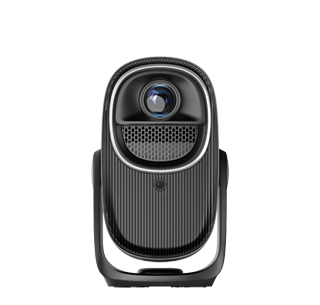
I. Core Advantages for Small Spaces
1. 800 ANSI Lumens Brightness: Balanced Clarity in Compact Spaces
This projector boasts 800 ANSI lumens of brightness, striking a balance
between energy efficiency and visual performance. This is sufficient to deliver
clear images in small spaces (e.g., rooms of 10-25 square meters) without
requiring complete blackout. In soft ambient light during the day (e.g., with
curtains drawn but not completely closed), it maintains sharp text edges and
vibrant color contrast, avoiding the dimness and washed-out appearance common in
low-lumen projectors. At night, it dynamically adjusts brightness to reduce eye
strain, making it suitable for extended viewing sessions (e.g., movie nights or
work presentations).
2. Short-Throw Design: Space-Saving Projection Logic
The key to short-throw technology lies in its smaller projection ratio,
typically between 0.4:1 and 0.8:1. This means the projector can project a large
image from a shorter distance—for example, placing it 0.8-1.5 meters from a wall
or screen can project an 80-120 inch image. In small spaces where long-distance
placement is not possible (such as narrow bedrooms or compact living rooms),
this design eliminates the need to reserve space for long-distance projection,
avoids conflicts with furniture (sofas, coffee tables), and maximizes the use of
available space. Unlike standard projectors that require 2-3 meters to project a
similar size image, short-throw projectors can even be placed on a low cabinet
near a wall, reducing floor space usage.
3. Dustproof and Durable: Long-Term Reliability in Everyday Use
Most of these projectors use sealed or semi-sealed optical components (such
as dustproof lens caps or enclosed light source chambers), reducing dust entry
by more than 80% compared to open-type projectors. This not only prevents image
defects such as black spots or color shift caused by dust accumulation in the
internal lens, but also extends the light source lifespan to 20,000-30,000 hours
(equivalent to 8-10 years of use at 4 hours per day). For spaces with limited
space and inconvenient daily maintenance (such as disassembly for dust removal),
this durability reduces the hassle of long-term maintenance.
4. Flexible Installation: Adaptable to Limited Placement
Small spaces often have limited installation space (e.g., no ceiling
mounting points, narrow tabletop space), and these projectors solve this problem
with flexible placement options. They support desktop placement (bookshelf, TV
stand), wall mounting (using slim brackets), and even ceiling mounting
(low-profile design to avoid obstructing headroom). Furthermore, most models are
equipped with adjustable feet or non-slip bases to maintain stability on uneven
surfaces, ensuring the projection angle remains correct without frequent
adjustments.
II. Key Technologies for Small Space Adaptation
1. Optimized Projection Ratio: Precise Projection, Close-Range
Experience
The short-throw projection ratio (0.4-0.8:1) is achieved thanks to a
special lens design—using a wide-angle optical lens with a shorter focal length
to capture more light along a narrower path, ensuring uniform image expansion
and avoiding edge distortion. For example, a 0.6:1 projection ratio model only
needs a distance of 1.2 meters to project a 100-inch image, perfectly suited for
a 4m x 5m living room, even if the distance from the TV wall to the sofa is only
2 meters. This avoids the problem of "too small an image" for standard
projectors at short distances, and also avoids the problem of "projection path
being blocked" for ultra-short-throw projectors (which need to be placed
directly below the screen).
2. Keystone Correction & Autofocus: Easy Alignment
Small spaces often require projectors to be placed off-center (e.g., on a
side cabinet instead of directly in front of the screen). Built-in keystone
correction (vertical ±40°, horizontal ±30°) corrects trapezoidal distortion with
a single tap. Autofocus technology (driven by a TOF sensor or camera detection)
adjusts the focus within 2 seconds of power-on, eliminating the need for manual
knob rotation—essential for users who frequently move projectors between rooms
(e.g., from bedroom to home office).
3. Edge Compression Technology: Avoid Image Cropping
In extremely small spaces (e.g., an 8-10 square meter bedroom), even
short-throw projectors can experience "edge overflow" (image extending beyond
the wall). Edge compression technology allows users to crop 5-15% of the image
without losing core content, ensuring the entire screen fits the available wall
space. This feature also works on irregularly shaped walls (e.g., walls with
window edges or decorative panels), enabling projectors to adapt to
less-than-ideal small space layouts.
III. Typical Small Space Application Scenarios
1. Apartment Bedroom (10-15㎡)
Placing the projector on the bedside table (0.8-1 meter from the opposite
wall) allows for a 70-90 inch screen projection—eliminating the need for a large
TV and freeing up wall space for storage or decoration. 800 ANSI lumens of
brightness ensures clear viewing even in early morning window light, and noise
is low (≤30dB/eC).o mode) won’t disturb sleep when used before bedtime.
2. Small Living Rooms (15-25㎡)
Position the projector on a TV cabinet (1-1.5m from the wall) to create a
90-120 inch home theater screen. The short throw design avoids blocking the
projection path when family members walk between the cabinet and the wall, and
800 lumens balances brightness for both daytime TV shows and evening movies.
3. Home Offices/Studies (8-12㎡)
Use the projector as a secondary display: place it on a desk (0.6-1m from a
side wall) to project a 60-80 inch screen for spreadsheets, presentations, or
video conferences. 1080P resolution ensures text clarity (suitable for reading
small font documents), and wireless screen projection (Bluetooth/Wi-Fi) connects
to laptops or phones without cable clutter.
4. Small Commercial Spaces (e.g., Café Corners, Mini Stores)
In 15-20㎡ commercial areas, the projector can be mounted on a ceiling or
high shelf (1-1.2m from a display wall) to show promotional videos, menu boards,
or event information. The dust-proof design resists dirt from daily foot
traffic, and 800 lumens remains visible under overhead lighting.
IV. 2025 Purchase Supplement for Small Space Users
1. Parameter Verification: Avoid "False Claims"
Confirm native 1080P resolution: Ensure the projector uses a native
1920×1080 imaging chip, not "upscaled from 720P," to guarantee text and image
detail in small-screen projections (e.g., 60-80 inch).
Check brightness authenticity: Prioritize models with third-party
certifications (e.g., CVIA, ANSI) for 800 lumens—avoid uncertified products that
overstate brightness (actual output may be 500-600 lumens).
Confirm projection ratio range: Choose 0.5-0.7:1 for most small spaces;
0.4:1 (ultra-short throw) is only necessary if the distance from the projector
to the wall is ≤1m.
2. Function Prioritization: Fit Small Space Needs
Prioritize dual-band Wi-Fi (2.4G+5G) for stable wireless screencasting
—critical for small home offices where wired connections may clutter desks.
Opt for built-in speakers (10W+) if space doesn’t allow external speakers;
look for models with sound optimization (e.g., dialogue enhancement) for clear
audio in small rooms.
Choose compact size (width ≤30cm, weight ≤3kg) for easy placement on small
cabinets or shelves—avoid bulky models that take up too much space.
3. Detail Checks: Improve Daily Use Experience
Noise level: Ensure eco mode noise ≤30dB (quieter than a desktop fan) to
avoid disrupting work or rest in small, enclosed spaces.
Heat dissipation: Look for models with side or bottom air vents (not rear
vents) if placing the projector against a wall—prevents overheating from blocked
airflow.
Interface selection: At minimum, 2 HDMI ports (for connecting TVs, game
consoles) and 1 USB port (for media playback)—avoid models with too few
interfaces that limit device connectivity.
Read recommendations:
HN30B Portable - HN Series Projector
3d Projector 1080p full hd
Does the Projector Screen Flicker?










 Reviewed: