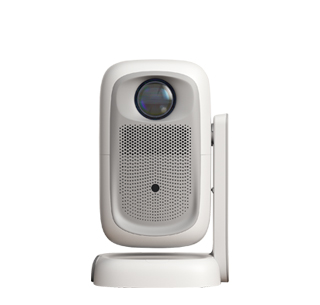
I. Core Advantages of TOF Laser Focusing and 4K Decoding
1. TOF Laser Focusing: Fast, Precise, and Convenient Alignment
TOF (Time-of-Flight) laser focusing technology utilizes a laser emitter to
emit near-infrared signals. These signals are reflected back to the receiver
from the projection surface (wall, screen), calculating the distance between the
projector and the projection surface in real time to achieve automatic focusing.
This technology solves many problems of traditional manual focusing and has the
following main advantages:
Ultra-fast response: Focusing is completed in 0.3-0.8 seconds, 5-8 times
faster than camera-based autofocus (which takes 2-3 seconds). Even when moving
the projector (e.g., from a table to a shelf), it can immediately refocus
without manual adjustment—ideal for impromptu viewing or switching between
multiple scenes.
High precision: Distance measurement error ≤2mm, ensuring sharp and clear
edges across the entire screen (no localized blur). It works stably on uneven
surfaces (e.g., textured walls, color screens) and in low-light environments
(e.g., dimly lit home theaters), avoiding focus failure due to low contrast of
the projection surface.
Intelligent Adaptive: Most models combine TOF focusing with automatic
keystone correction—after focusing, the projector automatically adjusts the
trapezoidal distortion (vertical ±40°, horizontal ±30°) based on the measured
distance, achieving a "one-click perfect image" without repeated manual
adjustments.
2. 4K Decoding: Upgrade 1080P Projection with High-Definition Sources
Although the projector's native resolution is 1080P (1920×1080), its
built-in 4K decoding function (supporting H.265, H.264, VP9, and AV1 encoding
formats) enables it to handle 4K UHD (3840×2160) video sources. This brings two
core benefits to users:
Reduced Image Compression Loss: When playing 4K movies, documentaries, or
games, 4K decoding retains more detail (such as facial textures in movies and
text in 4K slides) compared to projectors that only support 1080P (compressing
4K sources to 1080P, resulting in blurred edges or loss of fine information).
Future-proof content compatibility: With the increasing prevalence of 4K content
(such as Netflix 4K streaming, 4K Blu-ray discs, and 4K office documents), 4K
decoding ensures that projectors won't become obsolete due to the emergence of
high-definition content, avoiding the need to replace equipment to support new
content formats.
Optimized 1080p output: The decoder uses pixel enhancement technology to
upscale 4K source details to 1080p resolution, resulting in a final projected
image with richer color gradations (such as a sunset scene in a movie) and
sharper text (such as a 4K Excel spreadsheet in an office presentation) than a
standard 1080p projector.
3. 1080P Native Resolution: Balancing Image Quality and Practicality
1080P native resolution is the foundation of two advanced technologies:
It maintains a clear, pixel-free image on 80-150 inch screens (suitable for
spaces of 15-30㎡, such as living rooms or medium-sized conference rooms),
striking a balance between visual experience and equipment cost (4K native
projectors typically cost 2-3 times more).
Combined with TOF focusing technology, 1080P details (such as small text in
subtitles or fine lines in game maps) are fully rendered without blurring;
combined with 4K decoding, it avoids the waste of "over-decoding but
under-displaying," ensuring that every detail of the 4K source is converted into
visible 1080P image quality.
II. Key Technologies of Core Functions
1. TOF Laser Focus Explained
Working Principle: The TOF module emits 940nm near-infrared laser pulses
(invisible to the human eye) at a frequency of 100-200kHz. After the pulse
reaches the projection surface and reflects back, the receiver records the "time
of flight" (t). The distance (d) is calculated using the formula d = (c×t)/2
(where c is the speed of light), and this real-time data is transmitted to the
main chip to adjust the lens position for focusing.
Environmental Adaptability: Unlike camera-based focusing methods (which
rely on image contrast and perform poorly in low light or on monochromatic
surfaces), TOF laser focusing is unaffected by ambient light (it can operate in
environments with 0-1000 lux) and surface color/texture (it supports white
walls, gray screens, and even dark blue walls). Furthermore, due to the
narrow-band filtering in the receiver, it effectively suppresses interference
from other light sources (such as ceiling lights and sunlight).
Energy Efficiency: The laser module consumes only 5-8mA of current during
focusing, only one-third that of camera-based systems. This helps extend the
battery life of portable devices and reduces overall power consumption for
home/office use.
2. 4K Decoding Technology Details
Supported Formats: Covering mainstream 4K encoding standards:
H.265 (HEVC): The most common 4K format (used by Netflix, Disney+, and 4K
Blu-ray discs), it can compress 4K content to 50% of H.264 while maintaining
image quality, ensuring smooth playback even under limited network bandwidth
(e.g., 4K streaming bandwidth is only 10Mbps).
AV1: An emerging open-source format (used by platforms such as YouTube and
Amazon Prime), with a higher compression ratio than H.265, making it ideal for
high-bitrate 4K content (e.g., 4K HDR documentaries).
VP9: Used by platforms such as Go.Google platform (YouTube 4K), compatible
with 4K content on Android devices.
Decoding performance: Equipped with dedicated video decoding chips (such as
Amlogic T972, MStar 6A848), it can smoothly process 4K@60fps content (without
frame drops) and supports HDR10/HLG HDR formats—converting the wide dynamic
range of HDR to 1080p output, presenting richer dark details (such as night
scenes in movies) and brighter highlights (such as sunlight reflections).
Signal source compatibility: It can connect to 4K input devices (4K TVs, 4K
Blu-ray players, game consoles such as PS5/Xbox Series X) via HDMI 2.0+
interface, and can directly play local 4K files (USB 3.0) or stream 4K content
via Wi-Fi 5/6—no external decoder required.
III. Typical Application Scenarios
1. Home Theater (15-25㎡ Living Room/Bedroom)
Movie Night: The 4K decoding function allows playback of 4K HDR movies
(such as the 4K Blu-ray version of *Dune*), preserving rich details—the facial
textures of actors and the gradations of sand dunes are clearer than on
projectors that only support 1080P. The TOF focus function allows for quick
refocusing when the projector is moved (e.g., from the coffee table to the floor
for a movie night on the floor), without pausing playback.
Family Viewing: For families with children, the TOF focus function
eliminates the hassle of manual adjustments when children accidentally bump into
the projector—sharpness is automatically restored within seconds. The 1080P
resolution on the 100-inch screen balances visual comfort and eye protection,
suitable for extended viewing of animated films.
2. Gaming Scenarios (Console/PC Games)
Console Games: When connected to a PS5/Xbox Series X (outputting 4K game
visuals), 4K decoding preserves game details (e.g., textures of character
clothing, environmental details in *The Legend of Zelda: Tears of the Kingdom*),
while 1080p projection maintains a smooth frame rate (60fps). TOF autofocus
technology ensures that even if the projector is moved during gameplay, the
image immediately returns to sharpness, preventing game interruptions.
PC Games: For PC gamers using 4K gaming setups, the projector's 4K decoding
function performs uncompressed processing of the 4K signal, making text in the
game interface (e.g., skill descriptions, minimap) clearer. Combined with low
input latency (≤20ms in game mode), it provides a smooth gaming experience.
3. Office and Teaching Presentations (10-20㎡ Meeting Room/Classroom)
4K Document Display: When presenting 4K resolution PPTs (e.g.,
high-resolution product design diagrams, data visualizations), 4K decoding
ensures that every detail (e.g., small text in charts, color-coded data points)
is clearly visible on an 80-100 inch screen, avoiding the need for attendees to
crowd in front of small 4K monitors.
Quick Setup: In multi-meeting room scheduling, TOF focusing allows
projectors to be quickly moved and set up between meeting rooms without the need
for technicians to focus. Even when placed on uneven surfaces (e.g., stacked
books), automatic keystone correction (in conjunction with TOF) instantly
corrects image distortion.
IV. 2025 Buying Guide
1. Technical Specification Verification: Avoiding False Advertising
TOF Focus Authenticity: Confirm the projector uses "TOF laser autofocus"
(not "laser-assisted camera autofocus") – check specifications such as "TOF
module" or "0.3-second autofocus" (camera-based autofocus rarely achieves speeds
within 1 second). Test focus stability in a dark room or on a black wall
(camera-based autofocus may fail in this situation).
4K Decoding Integrity: Verify support for H.265 4K@60fps and HDR10/HLG –
avoid models that only support "4K@30fps" (may experience stuttering when
playing fast-moving content like sports) or "only support 4K video decoding"
(cannot decode 4K office documents). Check the HDMI version (must be HDMI 2.0 or
higher to transmit 4K signals).
1. Native 1080P Confirmation: Ensure your projector's native resolution is
1920×1080—avoid models labeled "1080P compatible" (these models upscale 720P to
1080P, resulting in blurry details when used with 4K decoders).
2. Choose Appropriate Parameters Based on Your Scenarios
Home Theater: When watching during the day with the curtains drawn,
prioritize brightness (800-1200 ANSI lumens) and contrast ratio (≥10000:1) to
enhance HDR dark detail. Choose a model with built-in dual speakers of 10W or
higher (or a soundbar supporting HDMI ARC connection) for an immersive audio
experience.
Gaming: Focus on input lag (≤20ms in game mode) and refresh rate (60Hz or
higher); select "Game Mode" to disable unnecessary image processing (thus
reducing latency). If using a gaming console, ensure it is compatible with HDMI
2.1 (it supports 4K@120fps signal transmission even if the projector output
resolution is 1080P).
For office use: In well-lit meeting rooms, select a brightness level
(500-800 ANSI lumens) and add wireless screen mirroring (dual-band Wi-Fi) to
share 4K documents. Look for an "Office Mode" that optimizes text clarity
(enhancing detail in 4K decoded documents).
3. Practical Experience and Precautions
Focus Stability: Test if the TOF focus drifts over time (e.g., after 1 hour
of use) – low-quality TOF modules may lose focus due to temperature changes.
Ensure the projector has a "focus lock" function to maintain sharpness.
Decoding Smoothness: Play 4K@60fps H.265 video (e.g., a 4K nature
documentary) to check for frame drops or audio/video synchronization issues –
poor-quality decoding chips can cause these problems.
Read recommendations:
HN30A Portable - HN Series Projector
Automatic Focus Video Projector
Fingerprint-Resistant Projector















 Reviewed: