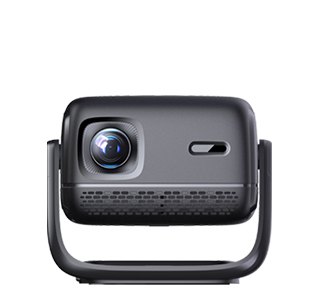
Projectors and laser TVs, though both used for large-screen display, differ significantly in core technology, installation requirements, image performance, and application scenarios. Firstly, in terms of light source and imaging principle, traditional projectors typically use LED, LCD, or DLP light sources, projecting light onto an external screen (such as a white screen or a gain screen) to form images. In contrast, laser TVs adopt laser light sources combined with ultra-short-throw projection technology; they are usually placed close to the screen (within 0.5-1 meter) and project images onto a special anti-light screen. This anti-light screen can effectively resist ambient light interference, making laser TVs more suitable for bright environments like living rooms without the need for dimming.
Secondly, in terms of installation flexibility, projectors offer greater versatility. They can be ceiling-mounted, table-mounted, or used with a tripod, and are compatible with various screen sizes (from 70 inches to over 300 inches), making them ideal for scenarios such as conference rooms, classrooms, and home theaters where screen size needs to be adjusted. Laser TVs, however, have fixed screen sizes (common sizes are 100 inches, 120 inches) and require matching special screens; their placement is relatively fixed, usually placed on a TV cabinet, which limits flexibility in adjusting screen size.
In terms of image quality and viewing experience, laser TVs have advantages in brightness and contrast. Due to the combination of laser light sources and anti-light screens, their brightness can reach 3000-5000 ANSI lumens, and the contrast ratio is often as high as 10000:1 or more, resulting in clearer and more vivid images even in well-lit rooms. Projectors, especially entry-level models, may have lower brightness (around 2000 ANSI lumens), and their image quality is easily affected by ambient light; high-end projectors with high brightness and high contrast can match laser TVs in dark environments but are more expensive.
In terms of lifespan and maintenance, laser TVs have a longer light source lifespan (up to 20,000 hours), which means they can be used for about 10 years without replacing the light source. Projectors using LED light sources have a lifespan of about 10,000-15,000 hours, while those using traditional bulb light sources need to replace the bulb every 2,000-5,000 hours, increasing maintenance costs. Additionally, laser TVs are generally more compact in design, taking up less space, while projectors (especially ceiling-mounted ones) require more installation space and may need to arrange cables in advance.
Read recommendations:
HW40 Home Cinema - HW Series Projector
Projectors with Smooth and User-Friendly Operating Systems
Projector Computer Screen Mirroring













 Reviewed: