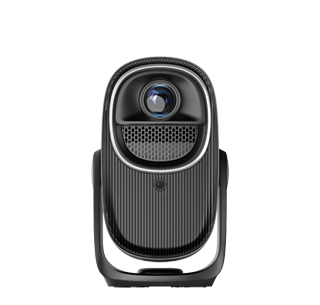
Projectors with excellent dynamic contrast deliver striking image depth by dynamically adjusting the ratio between bright highlights and dark shadows in real time, far outperforming static contrast projectors. Unlike models with fixed contrast ratios (which apply the same brightness level to all content), these projectors use advanced technologies like dynamic iris diaphragms, HDR (High Dynamic Range), and local dimming to optimize contrast for every scene—ensuring dark movies have rich, detailed shadows, and bright content retains crisp highlights without overexposure.
The core design of these projectors centers on dynamic contrast-enhancing technologies. A dynamic iris (mechanical or electronic) adjusts the projector’s light output based on content: it narrows for dark scenes (reducing light to deepen blacks) and widens for bright scenes (increasing light to boost highlights), creating a dynamic contrast ratio of 100,000:1 to 1,000,000:1 (vs. 5,000:1-10,000:1 for static contrast). HDR support (HDR10, Dolby Vision) further expands the contrast range by mapping brighter whites (up to 2000 nits) and darker blacks (down to 0.001 nits), matching the way human eyes perceive light. Some advanced models use local dimming—dividing the projection panel into zones that can be dimmed independently—for even more precise contrast control (e.g., darkening a night sky while keeping stars bright). These projectors also offer high resolution (4K preferred for HDR content), 2500+ ANSI lumens, and wide color gamuts (95%+ DCI-P3) to complement their contrast performance.
Application scenarios focus on content that demands visual depth. For home theater enthusiasts, they excel at movie watching: a 4K HDR projector with dynamic iris can render scenes from Dune—like dark desert nights and bright sunlit dunes—with stunning realism, making viewers feel immersed in the world. For gamers, they enhance gameplay: dynamic contrast ensures dark game environments (e.g., The Last of Us Part II) have visible enemies hiding in shadows, while bright explosions retain detail (avoiding “blooming” or washed-out areas). In professional settings (e.g., video editing studios), they display footage with accurate dynamic range, helping editors color-grade content to match how it will appear on cinema screens or high-end TVs.
When selecting these projectors, prioritize dynamic contrast technologies: mechanical irises offer more precise control than electronic ones, while HDR10+ or Dolby Vision support ensures compatibility with the latest high-quality content. For dark rooms, a dynamic contrast ratio of 500,000:1+ is ideal; for bright rooms, pair dynamic contrast with 3000+ ANSI lumens to cut through ambient light. Also, check for smooth iris transition—cheap models may have noticeable “pulsing” when the iris adjusts, which can be distracting. With their ability to adapt contrast to content, these projectors deliver the most lifelike images available.
Read recommendations:
HW30 Home Cinema - HW Series Projector
5000 Lumen High-Brightness Projectors for Training Rooms
Usage Method of Projector Wireless Screen Mirroring Device













 Reviewed: