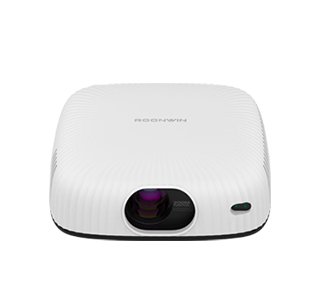
Projectors with high-contrast images deliver sharp, detailed visuals by maintaining a wide gap between the brightest whites and darkest blacks, ensuring dark scenes have rich depth and bright scenes retain clarity without overexposure. Unlike low-contrast projectors (which make images look “flat” or washed out), these models achieve high contrast through advanced optical designs (e.g., high-quality lenses, light-blocking panels), display technologies (e.g., DLP with micro-mirror control, LCD with high-transmittance filters), and contrast-enhancing features (e.g., dynamic iris, HDR)—making them ideal for content that demands visual detail, such as movies, games, and professional presentations.
The core design of these projectors focuses on contrast optimization. Native contrast (the projector’s inherent ability to produce dark blacks and bright whites) is a key metric—high-end models offer native contrast ratios of 10,000:1 to 100,000:1 (vs. 1,000:1-5,000:1 for basic projectors). This is achieved through light-blocking technologies: for example, DLP projectors use micro-mirrors that tilt to reflect light (for whites) or absorb it (for blacks), while LCD projectors use high-contrast filters that reduce light leakage in dark areas. Many models also include a dynamic iris— a mechanical or electronic component that adjusts light output based on content: narrowing for dark scenes (deepening blacks) and widening for bright scenes (boosting whites), further enhancing contrast. They support HDR (HDR10, Dolby Vision), which expands the contrast range to match real-world light perception, making HDR content (e.g., 4K movies) look more lifelike. In terms of resolution, they offer 1080p/4K, with 4K models delivering even more detail to complement high contrast.
Application scenarios focus on visual detail. For home theater users, high contrast brings movies to life: watching a night scene in Interstellar, the projector renders deep black skies with visible stars (no “gray” blacks) and bright spacecraft lights that don’t wash out surrounding details. For gamers, it enhances gameplay: in Dark Souls, high contrast makes dark dungeon corridors look atmospheric (with visible shadows of enemies) while bright torchlight retains clarity (avoiding “blooming” or blurriness). In professional settings (e.g., graphic design or photography), high contrast ensures accurate display of color gradients and shadow details—designers can judge how their work will look on high-end monitors or print. For presentations, it makes text and charts sharper: dark text on a bright background is more readable, even in moderately lit rooms, reducing eye strain for viewers.
When selecting these projectors, key factors include native contrast ratio, dynamic iris, and HDR support. Prioritize native contrast over dynamic contrast (native is more consistent across all content). A mechanical dynamic iris offers more precise control than an electronic one. HDR support is essential for 4K content, as it maximizes the projector’s contrast potential. Resolution should match your content: 1080p works for most movies/games, while 4K is better for high-detail content. Brightness of 2000-3000 ANSI lumens is ideal—too much brightness can reduce contrast in dark rooms, while too little makes images dim in well-lit spaces. With their ability to deliver sharp, detailed visuals, these projectors are perfect for users who demand the highest quality images.
Read recommendations:
HN30B Portable - HN Series Projector
compact Projector best price
Does the Projector Screen Flicker?














 Reviewed: