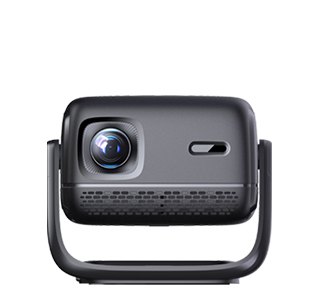
The connection stability of wireless projectors has been significantly improved with the advancement of wireless communication technology, but it is still affected by multiple factors such as network environment, technical specifications, and external interference. Currently, most wireless projectors use dual-band Wi-Fi (2.4GHz and 5GHz), Bluetooth 5.0 or higher, and some high-end models even support Wi-Fi 6E or Wi-Fi 7, which greatly enhance transmission speed and stability. For most daily use scenarios such as home entertainment, casual presentations, and online education, wireless projectors can provide a stable connection, but in complex environments, there may be occasional issues such as signal interruption, picture stuttering, or delay.
The 2.4GHz Wi-Fi band has strong penetration and a wide coverage range, making it suitable for large rooms or environments with multiple walls, but its bandwidth is limited (theoretical rate of about 300Mbps), which may struggle to support smooth transmission of 4K or higher-resolution content, especially in scenarios with multiple device concurrency. The 5GHz band, on the other hand, offers higher bandwidth (theoretical rate up to several Gbps) and less interference, making it ideal for high-definition content transmission and low-latency scenarios such as gaming. However, its penetration is weaker, and the signal may be significantly attenuated when passing through multiple walls. For example, in a room with multiple partitions, the signal strength of the 5GHz band may drop by 30%-50%, affecting connection stability. Additionally, external interference sources such as microwave ovens, baby monitors, and neighboring Wi-Fi networks can also disrupt the wireless signal, leading to connection instability.
To improve connection stability, many wireless projectors are equipped with advanced technologies such as dynamic frequency selection, Mesh组网, and optimized antenna design. For instance, some models can automatically switch between 2.4GHz and 5GHz bands based on the network environment, ensuring a stable connection. Users can also take practical measures to enhance stability, such as placing the projector and router within 30 feet, reducing the number of obstacles between them, avoiding placing the projector near interference sources, and updating the projector’s firmware and router’s drivers. In scenarios that require high stability, such as important business presentations or low-latency gaming, a wired connection (such as HDMI) is still more reliable, but for most casual use scenarios, wireless projectors can provide a stable and convenient connection experience. According to market research, with the popularization of Wi-Fi 6/7 technology, the connection stability of wireless projectors has been greatly improved, and the failure rate in daily use has been reduced to less than 5% for most high-quality models.
Read recommendations:
HI Gift Customization - HI Series Projector
Ferrite Isolator Temperature Coefficient Compensation
8G HDR Video Projector











 Reviewed: