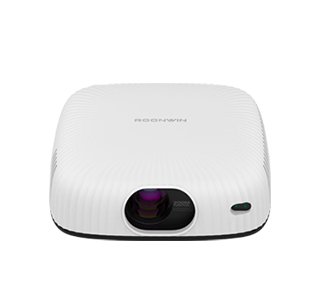
A projector built-in speaker is an integrated audio component within the projector, designed to deliver sound without the need for external speakers. While not as powerful or high-quality as dedicated audio systems, built-in speakers prioritize convenience, space-saving, and basic audio functionality, making them ideal for casual use scenarios—like small office meetings, bedroom movie nights, or quick presentations—where setting up external speakers is impractical.
The core characteristics of projector built-in speakers include power output, audio quality, form factor integration, and additional audio features. Power output is measured in watts (W), and most projector built-in speakers range from 2W to 15W—with 5W to 10W being the most common. Lower-power speakers (2W-5W) are typically found in portable projectors or budget models, suitable for small spaces (100-200 square feet) and close listening distances (3-6 feet). For example, a portable projector with 5W built-in speakers can provide clear audio for a 10-person meeting in a small conference room, where everyone is sitting close to the projector. Higher-power speakers (10W-15W) are found in mid-range home theater projectors, capable of filling larger rooms (200-300 square feet) with sound—though they still lack the bass and clarity of external speakers.
Audio quality of built-in speakers varies widely based on design and power. Most use small, full-range drivers that can reproduce mid-range frequencies (human voice, dialogue) clearly but struggle with low frequencies (bass) and high frequencies (treble). This makes them suitable for dialogue-heavy content—like presentations, TV shows, or documentaries—but less ideal for music or action movies, where bass is important. For example, during a presentation with video clips, the built-in speakers can clearly convey the speaker’s voice and the video’s dialogue, but an action movie with explosions would sound thin and lacking in impact. Some projectors use advanced speaker designs to improve quality—like dual drivers (for left and right channels) or bass reflex ports (to enhance low-frequency response)—but these are still no match for a dedicated soundbar or surround sound system.
Form factor integration is a key advantage of built-in speakers: they are designed to fit within the projector’s compact body, without adding bulk or requiring extra space. This is especially important for portable projectors, where size and weight are critical—adding external speakers would defeat the purpose of portability. For example, a portable projector like the Anker Nebula Capsule 3 weighs just 1.8 pounds and fits in the palm of a hand, with 8W built-in speakers that provide adequate audio for outdoor movie nights or travel use.
Additional audio features of built-in speakers include volume control, equalizer settings, and audio input options. Volume control can be adjusted via the projector’s remote control or physical buttons, making it easy to set the right level for the room. Some projectors have built-in equalizers (EQ) with presets like "Movie," "Presentation," or "Music"—for example, the "Presentation" preset boosts mid-range frequencies to make dialogue clearer, while the "Movie" preset enhances bass slightly. Audio input options allow users to connect external devices (like MP3 players or smartphones) to the projector’s auxiliary (AUX) or USB port, using the built-in speakers to play audio—turning the projector into a basic boombox.
Key considerations for using projector built-in speakers include room size, content type, and listening distance. Room size: built-in speakers work best in small to medium rooms—large rooms (over 300 square feet) will require external speakers to fill the space with sound. Content type: they are ideal for dialogue-heavy content but not for music or action movies. Listening distance: the closer you are to the projector, the better the audio quality—listening from far away will make the sound feel distant and weak.
In practical use, projector built-in speakers offer convenience for casual scenarios. A student uses a budget projector with 5W built-in speakers to watch lecture videos in their bedroom—no need for external speakers, and the audio is clear enough to hear the professor’s voice. A small business uses a projector with 10W built-in speakers for weekly team meetings—presentations with audio clips are easy to follow, and there’s no need to set up extra equipment. A traveler uses a portable projector with built-in speakers to watch a movie on a hotel wall—compact and convenient, with no cables or external devices to carry. For anyone seeking simplicity and portability, projector built-in speakers are a useful feature that eliminates the need for extra audio equipment.
Read recommendations:
HW40 Home Cinema - HW Series Projector
Low-Power Projector Supportable by Power Bank Power Supply
Solutions for Color Cast Issues of Three-Color Laser Projectors














 Reviewed: